
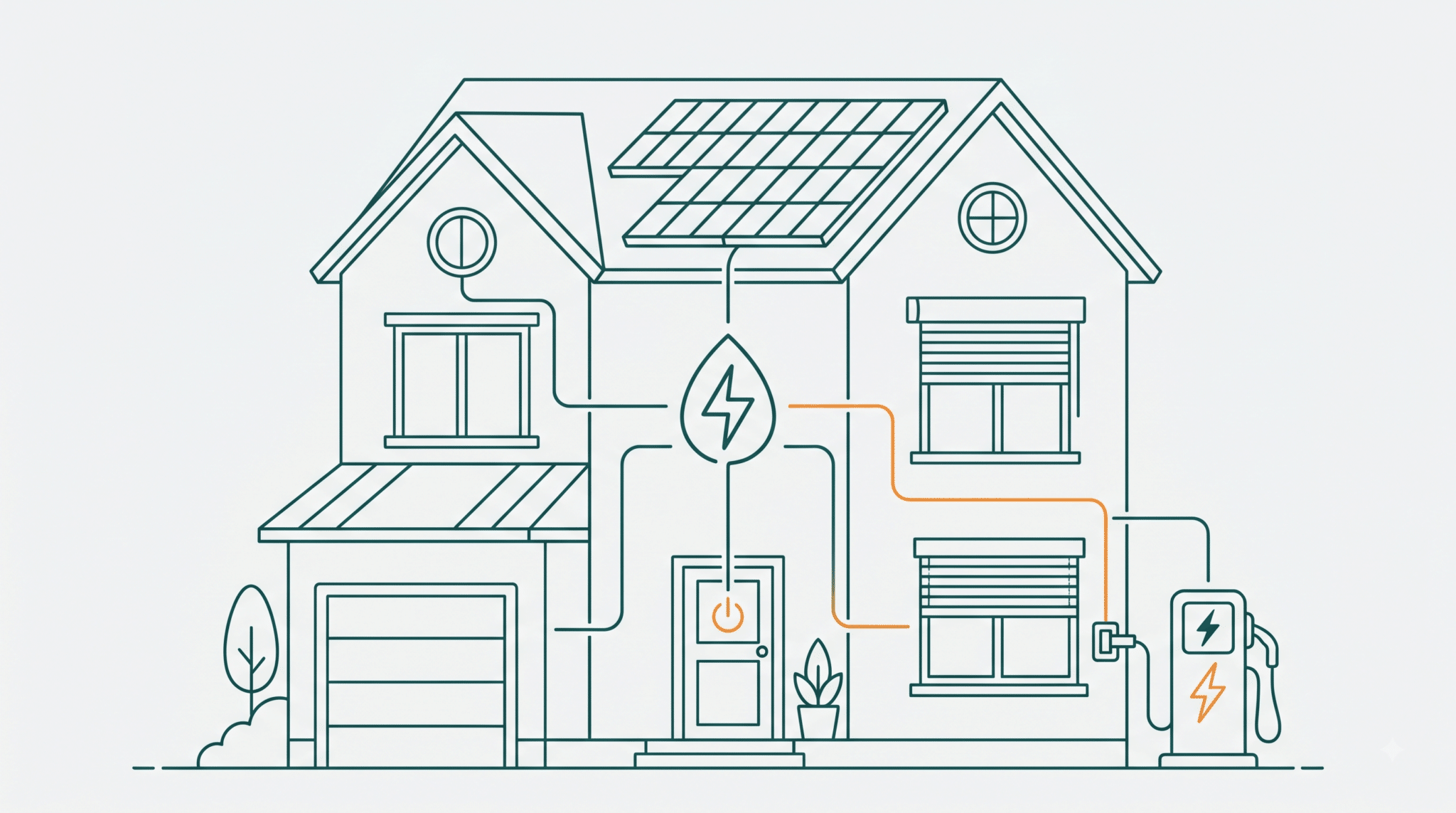
Living sustainably takes determination and awareness, and small changes add up faster than most people expect. Automation helps because it removes the part you have to remember.
Here’s the quick version:
- The thermostat is the big one in Arizona. Cooling dominates household energy use, so that’s where automation removes the most waste.
- Smart plugs are the cheapest way in, and the ones most people underuse.
- A leak sensor is the only item on this list that pays for itself by preventing a disaster rather than trimming a bill.
- Appliances are last for a reason. They cost the most and save the least per dollar spent.
Phoenix Metro Experts Discuss Home Automation Ideas For Your House
Most of what a house wastes isn’t dramatic. It’s a thermostat holding an empty room at 72 degrees all afternoon, and a flapper leaking behind a closed bathroom door for a month. Smart home technology helps here because it catches the boring, invisible waste rather than the kind you’d have noticed anyway. These devices automate basic tasks in a controllable way: managing lights and appliances, controlling thermostats, watching for water where it shouldn’t be.
We have been putting these systems into Valley homes since 1994, and the question we get is which ones are actually worth the investment. Below are five, ordered by how much waste each one actually removes per dollar spent. If you only do one, do the first. The exception is a house with somebody in it all day, which gains far less from the thermostat than an empty one does; if that’s yours, start at number two instead. Our home automation team installs all of them across the Phoenix metro.
1. Smart Thermostats
Start here. In Arizona, cooling isn’t one line on the bill. It’s most of it. ENERGY STAR puts heating and cooling at almost half of a typical annual energy bill, more than $900 a year, and in a Phoenix summer that share skews higher still.
A smart thermostat replaces a standard one and adds specific control plus remote access, usually through an app. You can program it to back off while the house is empty, see what you’ve actually been using, and cool the place down right before you get home from work. It also covers the household member who forgets to touch the thermostat on the way out, which is the real source of most waste.
The better units learn your schedule or use your phone’s location to work out when the house is empty. We’ve written more on that in four reasons to get a smart thermostat.
Will A Smart Thermostat Work With My Existing AC?
Usually, though it’s worth checking before you buy. Most units need a C wire at the thermostat to stay powered, and plenty of older Arizona homes don’t have one run. That’s solvable with an adapter or a short pull from the air handler. Multi-stage and heat-pump systems also need a thermostat that specifically supports them. Tell us your system and we’ll confirm compatibility before anything is ordered.
Does It Matter When I Use Power, Not Just How Much?
It does, in two ways. Peak evening demand is largely met by natural gas combustion turbines, which the EIA notes run at lower efficiency than combined-cycle plants, so a kilowatt-hour drawn at 6 p.m. tends to burn more fuel than the same one at noon. Shifting load off peak cuts fuel use. On a plan like SRP’s Manage Demand 5 to 10 p.m. it cuts your bill too. A thermostat that pre-cools before 5 p.m. does both.
2. Smart Lighting
The cheapest change you can make today is swapping incandescent bulbs for LEDs. The Department of Energy puts LED efficacy at up to 150 lumens per watt, lasting 30,000 to 50,000 hours against roughly 1,000 for an incandescent. That’s less energy, and far less waste over time, because you’re not throwing bulbs out every year.
A smart lighting system takes it further and lets you control the lights from your device. No remembering to turn anything off. You can kill every light in the house from one button, set timers per room, and have basement or bathroom lights switch themselves off when nobody’s in there.
If you want the detail on how that actually runs day to day, using lighting control with a home automation system covers scenes, schedules and away access. How smart lighting cuts an Arizona power bill covers the money side, and the perks of smart bulbs is the bulb level view.
3. Smart Plugs
Popular, cheap, and the item people underuse most. A smart plug runs on a schedule or a voice command and switches whatever you plug into it. Watch TV while you fall asleep and have it shut off on its own. Have coffee ready when you wake up. Turn off the hair straightener you remembered three miles down the road.
Two things put them ahead on value. They cost the least of anything here, and they’re the easiest to move: if a plug isn’t earning its place in one room, it goes in another. That’s not true of a thermostat or an appliance.
My opinion, and it’s an opinion: buy two before you buy anything else on this list. They’re the cheapest way to find out whether your household will actually use automation, and if the answer turns out to be no, you’ve spent very little finding out.
4. Water Leak Sensors
Water is the one resource Arizona can least afford to waste, and this is the item that addresses it directly. It also happens to be the only thing on this list that pays off by preventing a disaster rather than trimming a bill.
The numbers are worse than people assume. EPA WaterSense puts the average family’s household leaks at 180 gallons a week, roughly 9,400 gallons a year, and nationwide close to 900 billion gallons annually. In a state where water is the resource everyone is watching, that’s not a rounding error.
A leak sensor sits near an appliance or a fixture and alerts you when it finds excess moisture, a drip, or even a low temperature that suggests a freeze risk. You catch a plumbing problem before it becomes a claim, you cut the chance of mold, and you use less water without thinking about it.
Where Do Water Leak Sensors Actually Go?
Behind and beneath the things that fail. Water heater, washing machine, dishwasher, under sinks, and near the softener, which in Arizona you very likely have. Those are where slow leaks start and where nobody looks for months. A sensor at the water heater alone is worth having, because that’s the failure that empties a tank into a hallway rather than dripping quietly.
5. Eco-Friendly Smart Appliances
Last on the list on purpose. These are appliances built with smart capability so they run more efficiently, and the features that earn their keep are specific: keeping track of what’s in the fridge, door alerts, connecting to your phone.
They also cost considerably more than smart lights or plugs, and the efficiency gain per dollar is the smallest here. Buy one when your old appliance actually dies, and pick a smart model then. Swapping out a working fridge to save energy rarely pays back the energy it took to build the new one.
When the time does come, we can integrate a new appliance with the rest of your automation, including automatic water shutoff valves that pair with the sensors above.
Are Smart Appliances Worth The Extra Cost?
On efficiency alone, often not. On convenience and on catching problems early, frequently yes. The door alert that tells you the freezer has been open since breakfast saves more in one incident than the efficiency premium costs in a year. Judge them on what they prevent rather than what they save, and buy them at natural replacement time instead of early.
Which Of These Five Should I Do First?
Thermostat, then plugs, then a leak sensor at the water heater. That order tracks impact per dollar, not sticker price. Lighting slots in whenever you’re already changing bulbs or fixtures, and appliances wait for a natural replacement. If you’d rather sort the whole plan at once, six things worth sorting out before installation covers the planning, and whether smart home devices are worth the fiddle factor is a fair look at the annoyances.
Beyond The Five: Home Theater And Whole House Audio
Those five are the list. Two more are worth knowing about, because they are where the biggest hidden draw in most houses actually sits.
Automating The Home Theater
A media room is a stack of devices that are almost never all needed at once: receiver, projector or display, streamers, a console or two, a powered subwoofer. Most of them sit in standby around the clock, drawing a little each, and a rack quietly pulling power twenty four hours a day for a room used six hours a week is the definition of waste automation is good at removing.
One scene fixes it. Movie night powers up what the room needs, and stopping powers it back down rather than leaving everything idling. There is a second benefit that is not about electricity: projectors have finite lamp or laser hours, and a projector that shuts itself off instead of running through the credits and past bedtime lasts noticeably longer. That is a consumable you are not replacing. The components worth putting in a home theater covers what is usually in that rack.
Syncing Audio And Video Through The House
The wasteful way to get music in six rooms is six separate speakers, each with its own power supply, its own app, and its own standby draw. The efficient way is one source distributed to the rooms that need it, with zones that switch off when nobody is in them.
That is less hardware bought, less hardware idling, and less hardware thrown away in five years when the apps stop being supported. It also happens to sound better and work from one interface. Getting the most from a surround sound system covers the audio side, and we install whole house AV across the Valley including Gilbert and Tempe.
Don and his son Alex were at our home for three days updating the AV system throughout. This included renovating/updating all the electronics in a dedicated media room, the family room, the primary bedroom, and the whole house in ceiling audio system. They meticulously tweaked the audio settings for everything until it was essentially perfectly balanced.
J. Christopher Farmer ★★★★★
Contact Home Automation Experts In Phoenix
Ready to promote sustainability and convenience at home but not sure where to start? The team at Stabley Home Entertainment can answer your questions and help you work through the options. We’ll tell you which of these five fits your house, and which ones you can skip. Finished work is in the project galleries if you want to see it first.
We’re family owned and operated, and Arizona residents have been choosing us since 1994. If you’re moving into somewhere new and want this handled before you unpack, that’s what the move in tech packages are for.
Contact Stabley Home Entertainment today, or call (480) 325-5015.

Stabley Home Theater
1350 S Greenfield Rd #1127
Mesa, AZ 85206
Office: (480) 325-5015
Email: [email protected]
Website: https://stabley.net
Related Posts


